
Do yourself a fava
About 10,000 years ago people who lived around the eastern Mediterranean began purposely sowing the seeds of the wild wheat, barley, lentils, peas and chickpeas they had previously been gathering each year.
Among the earliest plants people cultivated was the broad bean, aka the fava bean.
In early human agriculture the broad bean was a breakout star – it had protein, fed humans and animals, and could also fix nitrogen into the soil.
If you lived around the Mediterranean broad beans were the bean – the only bean on the menu for around 9,500 years (beans which became our cannellini, pinto, kidney, haricot and borlottis didn’t arrive from the Americas until the 16th century).
Now if you want to impress your friends or you’re on a first date, slip into casual conversation that Australia is the fourth largest broad bean producer in the world.
And if you want to double down just add that over half of our 750,000 tonne harvest is eaten for breakfast in Egypt as ful medames – a mashy sort of porridge that’s dressed with olive oil, lemon, salt, cumin and garlic.
Of course most people know broadies from backyard veggie patches – something to harvest in spring when there’s not much else to pick (asparagus also take a bow).
My dad used to grow big patches of broad beans which Mum, like everyone else we knew, would boil until grey and serve with chops and mash. They smelled bad, tasted terrible and were equally feared and despised by me and my siblings.
For fifteen years after I left home not a single broad bean passed my lips until I met Joe Garita, who showed me how to peel a broad bean and eat it raw.
Bright green, so sweet and crisp – it changed fava for me forever.
In 1945, on his two-and-a-half-acre Merri Creek market garden, a twenty-year-old Joe Garita planted out the broad beans he grew up eating in Southern Italy.
At the end of each season he saved his biggest sweetest beans for next year’s seed.
Unlike regular broad beans that turned woody and bitter as they grew, Joe’s beans stayed sweet even when they got big.
Joe’s favas became locally famous, particularly with Lebanese people, who come harvest time would spontaneously appear at the fence, calling to Joe for the boxes of beans he would pick on the spot.
People would take 20 to 30 kilos to shell and freeze for meals that would transport them back home.
When Joe turned 80 in 2005 he handed his market garden on to CERES along with a large onion bag full of his broad bean seed.
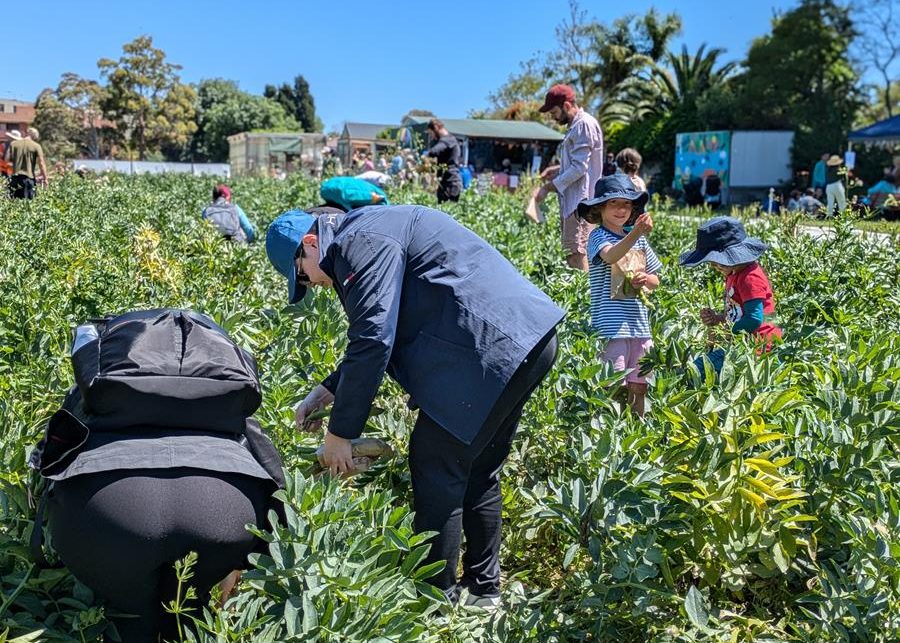
Now each year at broadie harvest time we celebrate Joe at the Festival of Fava, held on the farm that bears his name.
With local music, broad bean cooking, farm tours, children’s nature activities and of course U-Pick Joe’s broad beans, it’s one of CERES’ most joyful days.
The Festival’s on Saturday 10th October at Joe’s Market Garden in Coburg
Entry is pay as you feel.
Remember to book your U-Pick broad bean spot for the 10th or 17th of October here – limited spots on the day
Joe’s farm-gate will also be open for coffee, pastries and lots of farm-grown produce.
Have a great week
Chris